The belief that you need cash on hand before you can start earning is what actually keeps most people stuck — not any real gap in skill or ideas . It’s also not entirely true. Plenty of businesses today run on service, digital products, or resale models that need almost nothing to launch beyond time and a laptop.
This guide on how to start a business with no money breaks down real, practical ways to launch with little to no starting capital — no vague “just believe in This guide on how to start a business with no money breaks down real, practical ways to launch with little to no starting capital — skip the generic pep talk and get straight to approaches that work whether or not you have a loan or savings sitting behind you
Quick Answer
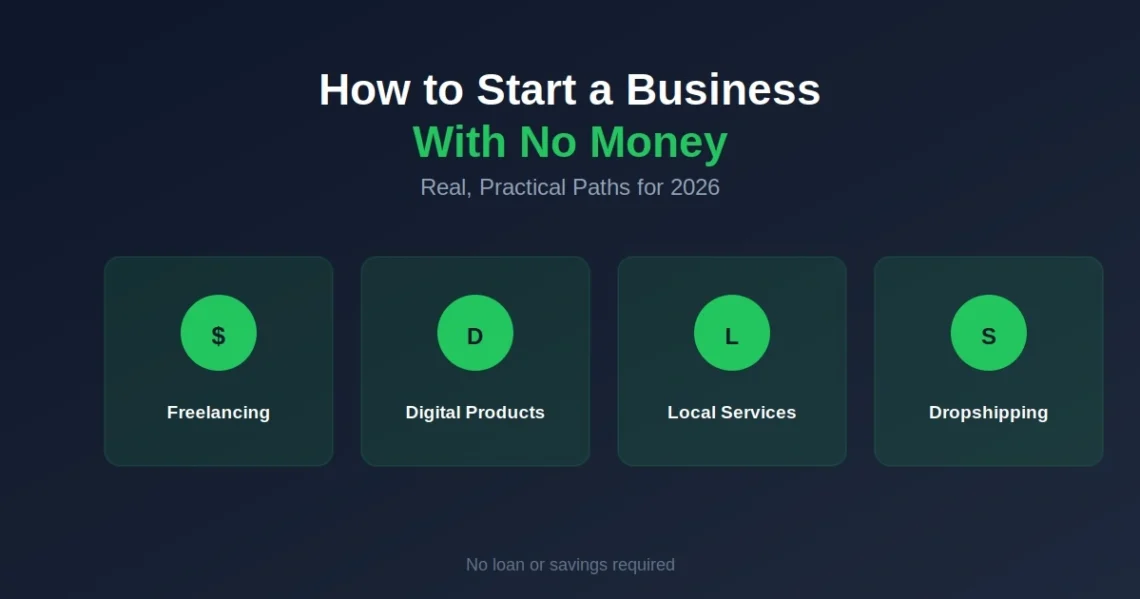
You can start a business with no money by selling a skill you already have (freelancing or consulting), reselling or dropshipping products without holding inventory, creating and selling digital products, or offering a local service using tools you already own.
Start With a Skill You Already Have
This is the fastest, lowest-risk path. If you can write, design, edit video, manage social media, do bookkeeping, or code, you can start freelancing today with zero startup cost beyond an internet connection.
- Create a simple portfolio (even a few sample pieces you make yourself)
- List your services on freelance platforms or reach out directly to small businesses
- Keep your rates modest in the beginning while you’re still collecting reviews, then increase them once you have proof of good work
This works because you’re selling time and expertise, not a product — there’s no inventory, no manufacturing, no upfront spend.
Offer a Local Service
Not every business has to be online. Services like lawn care, pet sitting, cleaning, tutoring, or moving help require little more than your own time and whatever equipment you already own.
- Start with people you know, then expand through word of mouth and local social media groups
- Use free tools (a basic website builder, a scheduling app, a group chat) instead of paid software early on
- Reinvest your first month’s earnings into better equipment or marketing, not before
Sell Digital Products
Digital products — templates, ebooks, presets, printables, online courses — cost nothing to “manufacture” beyond your own time, and can be sold repeatedly without holding inventory.
- Start with something inside your existing skillset — a spreadsheet template, a design asset, a written guide )
- Use free or low-cost platforms to host and sell it
- Resist the urge to launch ten half-built ideas — one product that’s actually finished and polished will outperform all of them.
Try Dropshipping or Print-on-Demand
Both models let you sell physical products without paying for inventory upfront. You list a product, a customer buys it, and a third party manufactures and ships it directly — you only pay once the sale is made.
- Research suppliers carefully; not all print-on-demand or dropshipping partners are reliable
- Margins are thinner than traditional retail, so pricing and marketing matter more than usual
- Start with a very small, focused product range rather than a huge catalog
Use Free Tools Instead of Paid Ones
Early on, almost every tool you need has a usable free version:
- Website builders with free tiers for a basic landing page
- Free accounting/invoicing tools for tracking income before you need full software
- Free social media scheduling tools for marketing
- Free email marketing tools up to a certain subscriber count
The goal isn’t to stay free forever — it’s to avoid paying for tools before you have revenue to justify them.
How to Start a Business With No Money and zero Credit
If a poor or nonexistent credit history is part of the concern, the service and digital-product paths above are especially useful, since they don’t require loans, business credit cards, or supplier credit to get moving. Building a short track record of income first — even a small amount — puts you in a much stronger position if you do eventually want financing to grow.
How to Start a Business Without any Experience
Lack of experience is less of a barrier than it seems for skill-based or service businesses. Most people learn the actual business side (pricing, client communication, basic bookkeeping) by doing it, not by studying it first. Start small, with one client or one product, and let the first few months teach you what a course or book can’t.
Reinvest Before You Expand
The businesses that grow from “no money” starts to something real almost always follow the same pattern: keep costs at zero for as long as possible, then reinvest early profit — not personal savings — into the next step, whether that’s better tools, a small ad budget, or outside help.
Common Mistakes to Avoid When You Start a Business With No Money
- Buying tools or inventory before making a single sale — validate the idea first
- Trying to do everything at once — one offer, done well, beats five half-finished ones
- Underpricing permanently — low prices are fine to start, but build in room to raise them
- Skipping the legal basics — even a no-money business usually still needs to register properly and understand local tax obligations
This article was researched and published by the Techsaaswrote Editorial Team to provide accurate, helpful, and up-to-date information for our readers.
Frequently Asked Questions
Can you really start a business with no money?
Yes — plenty of people start a business with no money using particularly service-based, skill-based, and digital product businesses, which require little more than your time and existing equipment to get started.
What is the easiest business to start with no money?
Freelancing based on an existing skill (writing, design, virtual assistance, tutoring) is generally the fastest and lowest-risk option, since it requires no inventory or upfront investment.
How do I start a business with no money and bad credit?
Focus on service or digital-product models that don’t rely on loans or supplier credit.A few months of real income behind you tends to matter more to lenders than a good credit score alone, so that’s worth building first.
Can I start a business with no money online?
Yes. Freelancing, digital products, and dropshipping/print-on-demand can all be started entirely online with minimal to no upfront cost.
Do I need a business license to start with no money?
Usually yes, even for a very small operation — requirements vary by location, so it’s worth checking local rules early rather than skipping this step entirely.
How long does it take to make money with no startup capital?
It varies widely, but service and freelance-based businesses often generate their first income the fastest, sometimes within the first few weeks, since there’s no product to build or ship first.
Can a teenager start a business with no money?
Yes. Service-based ideas like tutoring, pet sitting, lawn care, or selling digital products are common starting points for teenagers, since they require little more than time and existing skills. Depending on location, some business structures may need a parent or guardian involved for legal reasons.
Are there grants to start a business with no money?
Some grants exist for specific groups (certain industries, veterans, women-owned businesses, or local economic development programs), but they’re competitive and rarely a reliable primary funding source. Most people starting with no money rely on service-based or digital income first, rather than waiting on a grant.
Can I get a loan to start a business with no money?
Personal and small business loans are harder to qualify for with no revenue history or collateral. It’s generally more realistic to generate some income first through a low-cost model, then use that track record to support a loan application later if needed.
What’s the cheapest business to start with no money?
Freelancing based on an existing skill is typically the cheapest option, since it requires no inventory, equipment, or software beyond what most people already have access to.