
Your controller is in your hand. Your game is loaded. The connection is not working.This is the most common HSSGamepad frustration — and it is almost always fixable within five minutes once you understand how the connectivity HSSGamepad system actually works. The controller supports three distinct connection modes, each suited to different devices and use cases, and switching between them is not always obvious from the packaging or manual.
This guide covers every connection mode in plain language, step-by-step pairing for every major platform, the fixes that resolve the most common problems, and the specific situations where each mode outperforms the others.
Connectivity HSSGamepad — Complete 2026 Setup and Troubleshooting Guide
What Is the HSSGamepad and How Does Its Connectivity Work?
The HSS gamepad works across smartphones, tablets, and PCs using both wireless and wired connection options in a single device. Its connectivity system supports Bluetooth, a 2.4GHz wireless receiver, and USB-C wired connection.
Connectivity HSSGamepad refers to the full system of connection methods, pairing processes, and signal pathways that allow the controller to communicate with gaming devices. It is not just about which cable or wireless option you choose — it covers how quickly signals travel, how stable the connection stays under interference, how the controller switches between paired devices, and what happens when something goes wrong.
Each button press goes through several steps before your game registers it. You press the button, the controller picks up the input, processes it through its firmware, then sends it out through whichever connection — Bluetooth, dongle, or USB-C — is currently active. 2.4GHz dongle, your device decodes it, and finally the game engine executes the action on screen. Every step in that chain takes a small fraction of a second — and those fractions matter in fast-paced games.
Understanding this signal path explains why connection mode selection matters for performance — and why the same controller can feel responsive on one device and sluggish on another depending on which connection method is active.
The HSS Gamepad is a multi-platform gaming controller engineered for flexibility and performance. Android, iOS, Windows, Nintendo Switch, and cloud gaming platforms all work straight out of the box — no extra adapters or workarounds needed.
Three Connection Modes — Which One to Use
Connectivity HSSGamepad operates through three distinct modes. Each has specific strengths and specific situations where it outperforms the alternatives.
Mode 1 — Bluetooth Bluetooth connectivity pairs the HSSGamepad directly with a device without requiring any additional hardware. No dongle, no cable, no receiver — just a standard Bluetooth pairing through your device’s settings menu.
Best suited for: Android smartphones, iOS devices, tablets, Smart TVs with Bluetooth, and casual PC gaming where lowest possible latency is not critical.
Bluetooth 5.0 on the HSSGamepad produces a stable connection in most environments. The limitation appears in environments with heavy wireless traffic — apartments with many neighboring Wi-Fi networks, gaming events with multiple devices competing for wireless bandwidth, and setups where other Bluetooth devices operate simultaneously on the same device.
Mode 2 — 2.4GHz Wireless (Dongle) The 2.4GHz mode uses a USB dongle that plugs into the target device and creates a dedicated wireless channel between the controller and that specific device. This channel operates independently of Bluetooth and is not shared with other wireless devices.
Best suited for: PC gaming, competitive play where input lag matters, and any environment where Bluetooth interference causes connection problems.
The 2.4GHz connection delivers the lowest latency of the three modes. For competitive gaming where milliseconds matter, the dongle connection outperforms Bluetooth consistently.
The trade-off is hardware dependency — the dongle must be physically plugged into the target device. Losing the dongle removes access to this mode until a replacement is obtained.
Mode 3 — USB-C Wired The wired connection uses a USB-C cable to connect the HSSGamepad directly to a device. Zero wireless signal path, zero transmission delay, zero interference risk.
Best suited for: Situations where wireless reliability is critical (tournament play), devices without Bluetooth or USB dongle compatibility, and charging the controller simultaneously while playing.
The wired connection eliminates every wireless connectivity problem by bypassing wireless transmission entirely. Movement is limited by cable length, but the connection stability is absolute.
Step-by-Step Bluetooth Pairing by Platform
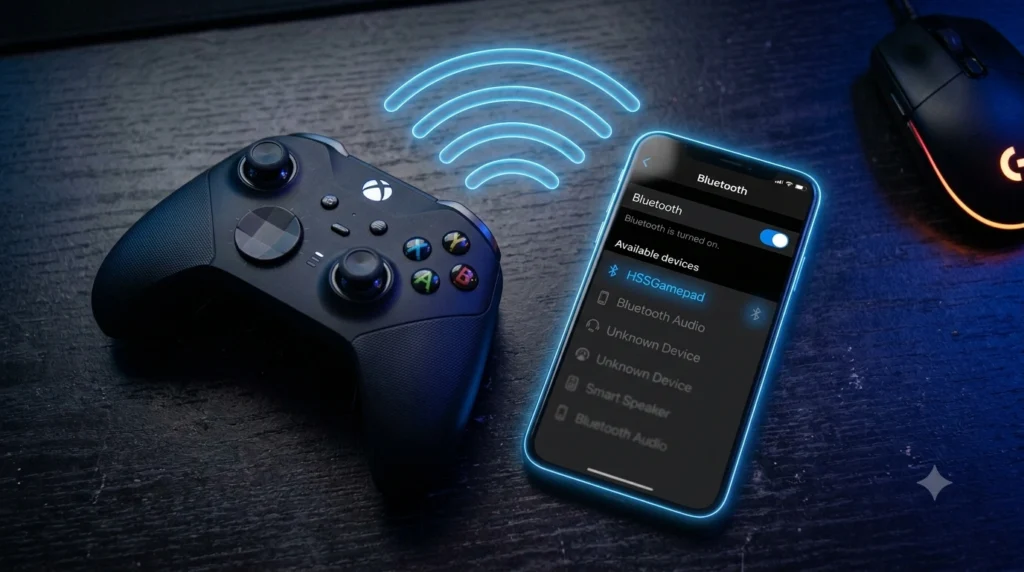
Android Pairing
Step 1 — Power on the HSSGamepad by pressing and holding the power button until the LED indicator lights up.
Step 2 — Enter Bluetooth pairing mode by pressing the Bluetooth button (or the designated mode button) until the LED begins rapid blinking. Rapid blinking indicates the controller is broadcasting and looking for a device to pair with.
Step 3 — Open Settings on your Android device and navigate to Bluetooth. Make sure Bluetooth is enabled and the device is scanning for available connections.
Step 4 — Select HSSGamepad from the available devices list. The LED will change from rapid blinking to a slow pulse or solid light once pairing is confirmed.
Step 5 — Test the connection by opening a compatible game or controller testing app. All buttons and analog sticks should respond immediately.
iOS Pairing
iOS maps buttons automatically in most games that support controllers — connect it and it just works in the majority of cases. The pairing sequence for iOS follows the same steps as Android. Enter Bluetooth pairing mode on the controller, open Bluetooth settings on the iPhone or iPad, and select HSSGamepad from the list. iOS controller support covers most modern games that support external controllers — check individual game settings to confirm controller support is enabled within the app.
Windows PC Pairing
Bluetooth pairing on Windows requires the controller to be in pairing mode before starting the Windows pairing sequence. Open Settings, navigate to Devices, then Bluetooth and other devices, and select Add Bluetooth or other device. Choose Bluetooth from the connection type options and select HSSGamepad when it appears in the discovered devices list.
For the lowest latency PC experience, use the 2.4GHz dongle connection instead of Bluetooth — plug the dongle into a USB port, put the controller in 2.4GHz mode, and the connection establishes automatically without a pairing sequence.
Fixing the Most Common Connectivity HSSGamepad Problems
Problem 1 — Controller Not Showing Up in Bluetooth Scan
This is the most frequently reported connectivity HSSGamepad issue and the one with the most straightforward resolution path.
Check that the controller is actually in pairing mode rather than just powered on. The LED behavior differs between these states — a solid light typically means powered on but not broadcasting, while rapid blinking means actively searching for a connection. Press the pairing button until rapid blinking begins before searching from the device.
Clear old pairing data from both the controller and the target device. On the controller, a full reset clears all stored pairing information — check the manual for the specific button combination. On the device, forget the HSSGamepad entry in Bluetooth settings before attempting to pair again. Old pairing data from a previous device causes connection failures that restarting the controller alone does not fix.
Problem 2 — Connection Drops During Gameplay
Your controller suddenly stops responding mid-game, sometimes with a disconnect beep and a frozen character on screen. This is often tied to battery levels or interference from nearby devices.
Check battery level first — low battery is the most common cause of mid-session disconnections. The HSSGamepad’s wireless transmission strength drops as battery depletes, producing intermittent disconnections before the controller fully powers off.
If the battery is adequate, interference is the likely cause. Wi-Fi routers, other Bluetooth devices, and neighboring wireless networks all compete for wireless bandwidth. Moving the gaming device and controller closer together reduces the effective distance the signal must travel. Switching to 2.4GHz dongle mode eliminates interference as a variable entirely.
Problem 3 — Input Lag
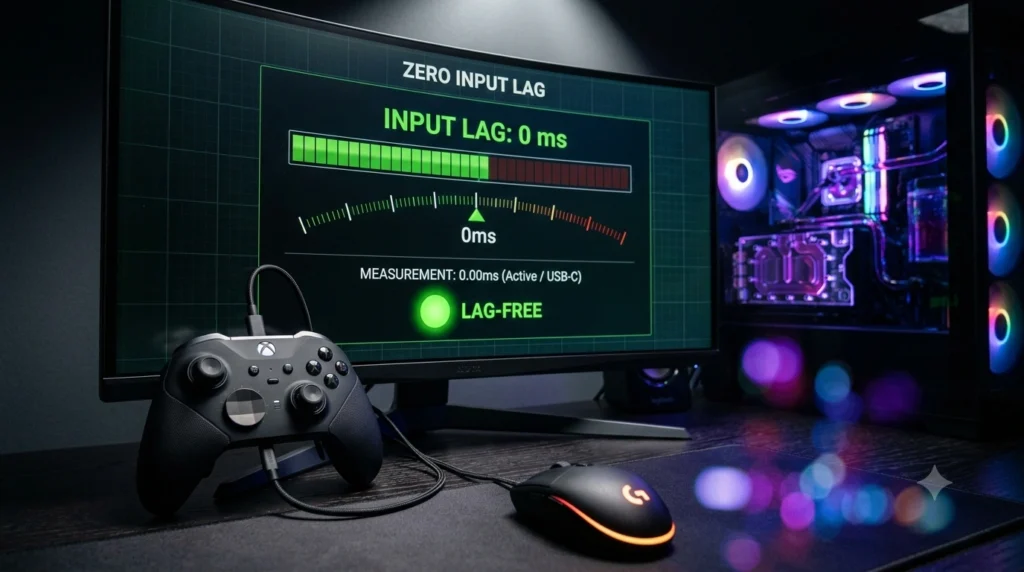
Perceived input lag — the delay between pressing a button and seeing the action on screen — has multiple potential sources in the connectivity HSSGamepad signal chain.
Switch from Bluetooth to 2.4GHz dongle mode. This change alone resolves most input lag complaints because it removes Bluetooth’s shared wireless bandwidth from the equation.
Check that the game’s internal controller settings are not adding additional input processing. Some games include dead zone, sensitivity, or input smoothing settings that add processing time between physical input and on-screen response.
Plug the dongle into a USB 3.0 port rather than USB 2.0 if available — USB 3.0 handles the data transfer faster and reduces processing delay at the device end of the signal chain.
Problem 4 — Controller Not Recognized on PC
Some Windows setups need a driver installed before the controller shows up as a recognized input device. If the HSSGamepad connects via Bluetooth or dongle but does not appear as a recognized input device in game settings, check Device Manager for any driver warnings on the controller entry.
Nine times out of ten this comes down to leftover pairing data or a driver that needs updating. Download the latest firmware or driver from the manufacturer’s official website if Windows does not install drivers automatically. After driver installation, unplug the controller and plug it back in so Windows picks up the new settings.
Problem 5 — Controller Connects But Buttons Don’t Work Correctly
Incorrect button mapping after a successful connection typically indicates a mode mismatch between the controller’s active mode and the target platform’s expected input format.
The HSSGamepad uses mode switching to optimize button mapping for different platforms. Verify the controller is in the correct mode for your target platform by checking the LED color indicator against the mode guide in the controller documentation.
HSSGamepad Platform Compatibility in 2026
For what it costs, the HSSGamepad covers more platforms than most competing controllers in the same price range . Understanding which connection mode works best on each platform avoids the trial-and-error that wastes setup time.
Android Full compatibility across Android 6.0 and above. Bluetooth is the standard connection method. Any Android game built with controller support will recognize the HSSGamepad the moment it connects — no tweaking required. Cloud gaming apps including Xbox Cloud Gaming, NVIDIA GeForce Now, and PlayStation Remote Play all support the controller through Android Bluetooth.
iOS Works across iOS gaming platforms without requiring adapters or workarounds. iOS 13 and above includes broad MFi and Bluetooth controller support. Connect via Bluetooth and verify controller support is enabled within individual game settings — not all iOS games support external controllers regardless of connection quality.
Windows PC Both Bluetooth and 2.4GHz dongle connections work on Windows. For competitive gaming, the dongle connection outperforms Bluetooth on latency. Steam’s controller support settings recognize the HSSGamepad and allow custom button mapping within Steam Input for games that do not natively support it.
Nintendo Switch Compatible with Nintendo Switch without requiring adapters or workarounds. The Switch recognizes the controller through Bluetooth pairing in the controller settings menu. Not all Switch games support third-party Bluetooth controllers — verify compatibility for specific titles before committing to this platform combination.
Smart TV and Android TV Smart TVs with Bluetooth support pair with the HSSGamepad for cloud gaming apps, streaming service gaming, and Android TV gaming content. Connection stability on Smart TV varies more than on dedicated gaming devices — proximity to the TV and minimizing competing wireless devices in the environment improves performance.
Getting the Best Performance from Connectivity HSSGamepad
Several habits consistently improve the connectivity HSSGamepad experience beyond the initial setup.
Keep firmware updated Manufacturer firmware updates address known connectivity bugs and occasionally improve latency performance. Check the manufacturer’s official page periodically for firmware releases — updating requires connecting via USB-C and running the update utility.
Charge before extended sessions Running the HSSGamepad below 20% battery during gaming sessions invites the mid-session disconnections described in the troubleshooting section. Charging between sessions rather than running to empty extends both session reliability and long-term battery health.
Minimize interference in 2.4GHz mode The 2.4GHz wireless channel performs best when other 2.4GHz devices are minimized nearby. Wi-Fi routers set to 2.4GHz band create competition for bandwidth. Setting your router to 5GHz-only in environments where gaming performance matters removes this interference variable.
Use the right mode for the right situation Bluetooth for casual mobile and tablet gaming. 2.4GHz dongle for competitive PC gaming. USB-C wired for tournament play or charging sessions. Matching the connection mode to the use case eliminates most performance complaints before they develop.
Store properly Storing the controller with the dongle plugged into the dedicated storage compartment — where available — keeps the dongle with the controller and prevents the loss that removes access to 2.4GHz mode entirely.
Frequently Asked Questions
What does connectivity HSSGamepad mean?
Connectivity HSSGamepad refers to the full system of connection methods, pairing processes, and signal pathways through which the HSS gaming controller communicates with devices. It covers the three connection modes — Bluetooth, 2.4GHz wireless dongle, and USB-C wired — as well as the pairing process for each platform, signal stability performance, and troubleshooting when connections fail. Good connectivity keeps every button press sharp and the connection solid from start to finish — no freezes, no drops, no delays.
Which connectivity mode is best for competitive gaming on HSSGamepad?
The 2.4GHz wireless dongle mode delivers the lowest input latency of the three connectivity HSSGamepad modes and is the best choice for competitive gaming. It creates a dedicated wireless channel between the controller and dongle that operates independently of Bluetooth and is not shared with other wireless devices. For tournament or competitive play where absolute reliability matters most, the USB-C wired connection eliminates all wireless variables entirely.
What causes the HSSGamepad to drop connection mid-game?
The two most common causes of mid-session connectivity HSSGamepad disconnections are low battery level and wireless interference. Check battery level first — the controller’s wireless transmission weakens as battery depletes. If the battery is adequate, interference from nearby Wi-Fi routers, other Bluetooth devices, or neighboring wireless networks is the likely cause. Switching to 2.4GHz dongle mode eliminates interference as a variable and resolves most random disconnection problems.
Does the HSSGamepad work on iOS and Nintendo Switch?
Yes. Connectivity HSSGamepad supports iOS through standard Bluetooth pairing — iOS 13 and above includes broad controller support that the HSSGamepad works within. Nintendo Switch also supports Bluetooth controller pairing through the Switch’s controller settings menu. Compatibility with specific games on both platforms varies — not all titles support third-party controllers regardless of connection quality, so verifying game-level support before relying on the controller for a specific title is recommended.
How do I fix HSSGamepad input lag?
Input lag with connectivity HSSGamepad has three primary fixes in order of likely impact. First, switch from Bluetooth to 2.4GHz dongle mode — this single change resolves most lag complaints by removing shared wireless bandwidth from the signal path. Second, plug the dongle into a USB 3.0 port rather than USB 2.0 for faster data processing at the device end. Third, check game-specific input settings for dead zone or input smoothing options that add processing time between physical button press and on-screen response.
Conclusion
Connectivity HSSGamepad problems almost always fall into one of a few predictable categories — wrong pairing mode for the target platform, low battery causing signal degradation, wireless interference disrupting the connection, or old pairing data creating conflicts. Each of these has a direct fix that works reliably once you know what you are looking for.
The three-mode system — Bluetooth for mobile and casual play, 2.4GHz dongle for competitive PC gaming, USB-C wired for absolute reliability — covers every gaming scenario the HSSGamepad is designed for. Matching the connection mode to the use case and following the platform-specific pairing steps in this guide eliminates the trial-and-error that makes controller setup frustrating. Once the connection is stable, the controller disappears from your awareness — which is exactly what good connectivity HSSGamepad performance should feel like.
This article was researched and published by the Techsaaswrote Editorial Team to provide accurate, helpful, and up-to-date information for our readers.